The Archive Cafe – a digital detox

Modern digital life is tiring and draining. There are a lot of cranky, socially isolated people staring into their screens or tuning into their airpod-casts.

But there’s also the Archive Cafe in Saint Gilles, Brussels. It’s an independent coffee shop located on Avenue Adolphe Demeur close to the town hall. The specialty coffee is crafted and the baked treats are top-notch, yet Archive is much, much more than a place to caffeinate and refuel.

It seems to possess an almost magical ability to create community and buck the negative trends that surround us. Maybe it’s the vinyl albums you can browse as you wait for your coffee to be made. Maybe it’s the barista, a chill, brown haired woman who seems to be on a first-name basis with everyone and exudes unambiguously positive energy as she DJs her way through the vinyls, chats with customers or just with herself, and serves up delicious brews. Maybe it’s the fact that you can still pay in cash. Maybe it’s simply the location, in one of the more trendy and relaxed neighbourhoods in Belgium’s capital.

Sure there are smartphones even here. But you also see people writing poems in notebooks, reading paperbacks and talking across tables to each other. Dogs are welcome. Babies are welcome. And I always feel welcome too.

It’s a small oasis in the modern dystopia that surrounds us: unpretentious, friendly and positive. A reminder that not everything is online. And not everything is shit.

My review of Jo Nesbo’s “Blood Ties”

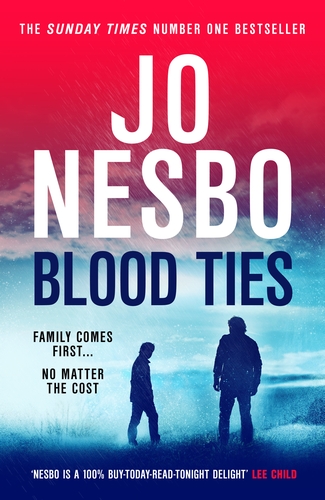
Blood Ties by Jo Nesbø

My rating: 1 of 5 stars


In these days of AI generated content, there is much talk about the ‘uncanny valley’ – where visual effects are neither purely cartoonish, figurative representations of reality; nor are they close enough to pass as photorealistic. Instead, they are in between, and create an uncanny sense of something that is ‘almost’ real.
Jo Nesbo’s Blood Ties occupies the uncanny valley of the written word, in between the genre of Scandi crime fiction, and actual literature. What makes the effect so unpleasant is that the book has some features of real writing to it. Nesbo wants to be a serious writer, and achieves that in places. At the same time, he is cursed with muscle memory from years of cranking out many, many scandi murder stories; he cannot quite escape the ridiculous and cartoonish tropes that made him a wealthy writer of comfortably bad genre fiction.
What results is simply awful. A truly unlikable protagonist named Roy who plods through the uni-dimensional, clumsy plot at a slow and pedestrian pace, yet still finds time to embroil himself in action scenes that are as unrealistic as they are unnecessary.
Worst of all is the warped moral lens through which the reader is forced to view Roy and his uninspiring mission to build a roller coaster in rural Norway. Nesbo tries hard to make the reader sympathise with this guy by backsplaining his childhood abuse into the narrative with a blunt instrument, yet even the heavy spice of child abuse feels so uncannily fake as to leave us emotionally cold. Meanwhile, in the present time, Roy’s brute-boy morality and sordid affair with a young woman are the side plot to his attempts to escape justice for the many murders we know he and his brother Carl committed in the past. Is Roy remorseful? It’s actually hard to say, because the character is so poorly written. Perhaps sensing that the child abuse doesn’t quite make Roy the likeable underdog the author was hoping to craft, Nesbo resorts to making the minor characters even less charismatic than the protagonist, so that Roy can shine by comparison.
It doesn’t work. Nesbo’s warped moral lens does little more than give the reader a headache and make him want to leave that depressing Norwegian town forever. Whatever Roy’s childhood, however corrupt and petty the cops and bankers that inhabit the town of Os, most of me wanted him to get caught and go to jail. But I didn’t want it badly enough to keep reading. I made it about halfway through, before committing my own sort of crime:

Leaving my paperback copy of Blood Ties at an Airbnb, for some other unsuspecting reader to suffer the same fate as me.


View all my reviews

My review of Shakespeare’s Hamlet

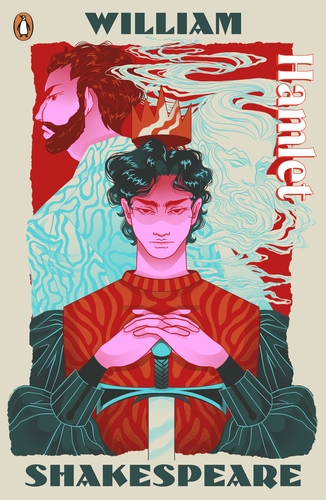
Hamlet by William Shakespeare

My rating: 5 of 5 stars


To read or to watch on stage? That is the question when it comes to Shakespearean plays. And there is a clear consensus among middle class parents of teenagers condemned by the school curriculum to the former: it is better to take seats amidst a sea of theatregoers, than to suffer pages full of the slings and arrows of outrageous Elizabethan word salad.
I will make so bold as to disagree. I think you need to do both. First read and study, then go and watch a great performance. And while reading the first few of the Bard’s plays might feel toilsome, it is the only way to truly steep yourself in a language that – let’s face it – has grown archaic even to the most literate among us.
So as I picked up Hamlet to read it for the very first time, I thanked my English teachers who, 35 years ago, I once cursed for forcing me to chore through Merchant of Venice, Romeo and Juliet, King Lear…And I’m glad I saved the best for last.
For one thing, it is replete with quotable quotes I knew but did not know came from Hamlet; phrases woven deep into our cultural fabric – everything from the Rotten State of Denmark, to ‘Never a Borrower nor a Lender be’, to ‘the lady doth protest too much, methinks’, to the latest Taylor Swift song, and many more I’ll leave for the reader to discover himself.
Beyond that, Hamlet is a cracking good story. It is the mother of all whodunnits – for though Hamlet’s father the king is dead, was he murdered? And if so, by whom? It is also the progenitor of the ‘unreliable narrator’ device. Can we believe that Hamlet’s interaction with the ghost is something more than a manifestation of his crescent madness?
And it is the prototype for the psychological thriller: the internal struggle the young prince endures when faced with the decision of whether to avenge his father’s death or to accept it not only gives rise to the most memorable quotable in Shakespeare’s oeuvre, but it is also a delicate and meaningful treatise on the nature of courage and cowardice. The poignancy with which Hamlet’s prevarications contrast with the bold decisiveness of the similarly wronged Laertes is so sharp it almost causes the reader to wince.
Most of all, though, we readers of this great play must never forget that Hamlet is what the middle class parents of high school scholars proclaim it to be: a set of instructions to actors, so that they can put on a show. Now that I have suffered my slings and arrows, I can’t wait to book a ticket and see this masterpiece come to life.


View all my reviews

Happy St Patrick’s Day!

Dear Daniel,

I find myself thinking of you especially today, as the sun shines on yet another March the 17th. St. Patrick’s Day is the saint day of the patron saint of Ireland, and although you may not know it, you should remember that you are Irish too.

Who knows? The day may come when you and I will walk together through the green fields of Ireland and feel the gentle rain against our faces, before tucking in, somewhere, to a bowl of chowder and a pint of Guinness.

In the meantime: be well, my son. May the road rise to meet your feet, and may the wind be always at your back.

Love,

Dad

Thoughts on Trump/Bibi’s War with Iran

Recording your thoughts on current events is a perilous undertaking. Without the benefit of hindsight, it’s easy to get things wrong. And because, on the occasions you manage to get something right, your predictions are often drowned out by the noise of consequence or else simply forgotten, there is little upside to doing so. Yet current-event blogging is important, because it is a way of keeping yourself intellectually honest. Like validation exercises for modelling, it is the best test of whether your world view has any actual predictive power.

With that preamble in mind, here are my thoughts on the four-day-old war the American Empire has just begun against the Islamic Republic of Iran.

Why did the Empire strike? And why now? Four reasons I can see…
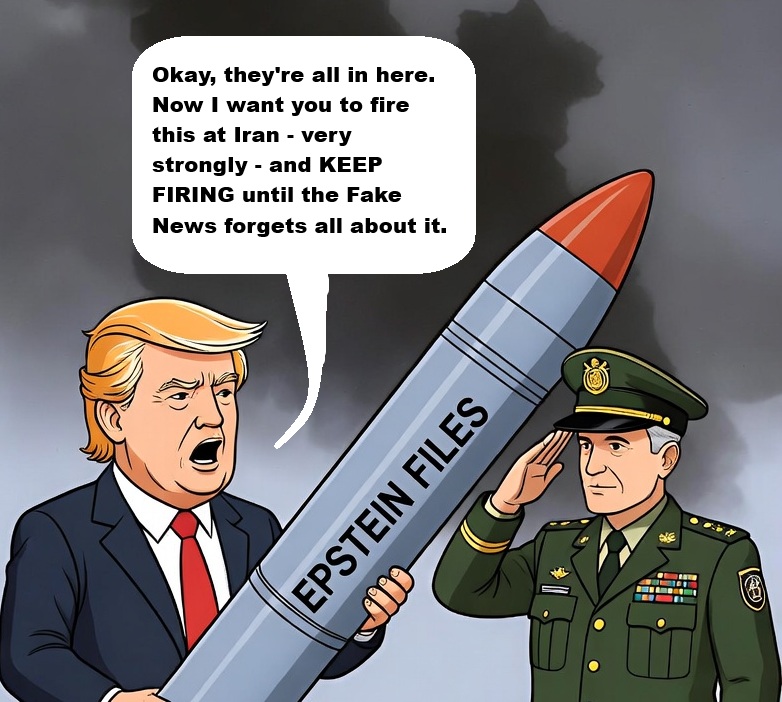
As I see it, the cause of this war sits at the intersection of four distinct motivations. First, the Trump Administration is eager to win a hand of poker. And if a win isn’t possible, at least distract from the last few bets they’ve lost: the US economy, the Epstein files, the summary execution of ICE protestors in Minneapolis…This may sound like a banal, petty and ridiculous reason to risk US lives and take foreign ones, but my experience of how decisions get made is that they are often far less statesmanlike than people suppose.

The second motivation for war is almost as banal, and more sinister. It is that the American Empire has unparalleled military strength via the largest military industrial complex in human history. If you have all those chips on the table, you gotta play a few hands of poker. This means that even if Trump had the most pacifist instincts in the world, he sits on top of an executive power that wants war the way a 10 year old boy wants to run around outside and kick a ball.

The third reason is less banal, yet far, far more sinister. It is that the cancer of the American Empire does not reflect the wishes – or even the interests – of the citizens of the Republic it has grown out of. In the case of the Iran war, this should be patently obvious: an overwhelming majority of Americans oppose the war, yet yesterday their Congressmembers were unable to curb the President’s blatantly unconstitutional act of aggression. Instead, the Empire represents a web of interests that are diffuse across the globe, but are somehow strongly aligned with the interests of Israel. And Israel has a clear incentive to topple the Iranian regime – not to replace it with some kind of functioning democracy that will improve the lot of the Iranian people, but to do what they have done in Lebanon, Syria and Iraq: create a dysfunctional chaos state that cannot challenge their regional hegemony.

The fourth and final reason is the most important for determining the effects of this conflict on geopolitics. It is the connection Iran has to Asian Powers and in particular China. In a sense, the Empire is not attacking Iran as much as chipping away at China’s network of interests in the region. Iran has oil that it sells independently to China. My bet is that when the dust settles on this conflict, that will no longer be true.

The Empire’s army really does kick donkey
It might seem like an obvious point to those who understand the game of war better than I do, but to me, it is somewhat surprising to see how one-sided the combat has been so far. It’s not just that Iran has no cards to defend itself against American/Israeli aerial and ballistic assaults, but its regional allies, China and Russia, have clearly prejudged the outcome of this conflict and understand that there is no point in backing a loser. This, despite the clear incentives they have to keep the Iranian Regime in power.

Contrast this with Russia’s campaign against Ukraine. To be clear, Russia has enough chips in its stack that, as the blinds get raised, it will eventually grind out some kind of victory (however Pyrrhic). But Russia is utterly unable to dominate the skies the way the Empire has – not even the skies over its own territory, as we saw when the AFU staged an incursion into the Kursk region two years ago. This is worth reflecting on. For all the talk of a ‘multipolar moment’, no one, not even China or Russia, has the power to stand against the Empire’s armies.

Europe is an irrelevant patchwork of vassal states...with nice architecture
This is also not a particularly insightful or novel observation, yet the level of hand-wringing and ‘close monitoring’ coming out of Brussels is truly a sight to behold. With the notable exception of Spain, the Member States of the EU are breathtakingly unable to formulate a coherent position in the face of, not only flagrant violation of international law and the aims which it is constitutionally bound to uphold (i.e. promotion of peace), but also of their own self-interest. After orchestrating the bombing of the EU’s pipeline gas supply from Russia, the Empire has now bombed its way into a situation whereby America’s only competitor for selling LNG to Europe (Qatar) has left the table. Coincidentally.

Rumours of the Empire’s demise are greatly exaggerated
The lesson the Empire’s forces learned from Iraq and Afghanistan is that you don’t need boots on the ground to achieve your aims, if your aims are to destroy, fragment and keep weak. Libya and Syria have shown that there exists such a strategy as ‘managed chaos’, in which a regime can be cheaply overthrown through a clever combination of precision warheads and intelligence. You might not be able to pinpoint what will arise from the ashes, but it will likely be weaker than the thing you toppled – and if not, you can always bomb, wait and repeat.

This appears to be Iran’s fate. And if I’m right, China will see itself weakened by this. It’s a small but significant unravelling of the nascent coalition that was rising to challenge the Empire’s global hegemony. Seen like this, the better poker move for Beijing would have been to go all-in on backing Iran, risking full-scale war with the Empire in order to force Washington and Tel Aviv to fold. But as I said before, the evidence from the rubble so far is that China didn’t have the cards, the chips or frankly the moxie to back that bet.

So despite all the chatter about de-dollarisation, the fractured transatlantic relationship, BRICS, the past few days have shown that we still live in a unipolar moment. US citizens might lose, the Iranian people are almost sure to lose. China and Europe will also likely lose. But the American Empire will remain the clear chip leader.

Let me ruin every Western movie for you

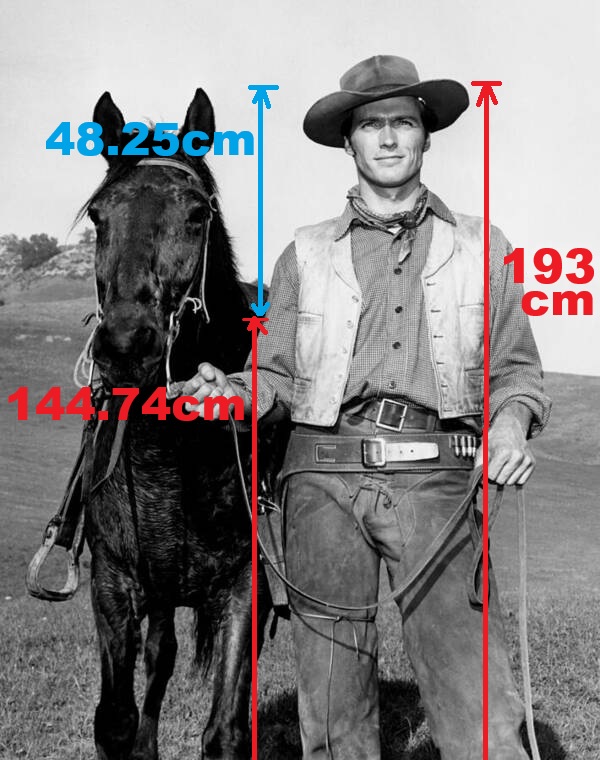
What is the one thing you associate most with Westerns? Horses, right? Wrong! There are actually almost no horses in any Western movies you will ever watch. To prove the point, consider this picture of Clint Eastwood from the classic Rawhide, standing next to a ‘horse’:

Clinty Eastwood came to town, riding on a pony…

From this photo, we can see fairly clearly that the ‘withers’ of the equine in question (i.e. the ridge between the shoulder blades) reach up to just below Eastwood’s nipples. As any artist who has studied human anatomy can tell you, the distance from nipple to the top of the head is about 25% of total height.

Now we know Eastwood to be a tall man – the internet reliably informs me that he is in fact 193cm (6’4″) in height. Therefore we can estimate the distance from Eastwood’s crown to his nipple to be 48.25cm. Given the ‘horse’ and Eastwood are standing side by side, this yields a height from withers to hoof of 144.74cm.

But here’s the rub, fellow movie-watchers: Any equine below 147cm (14.2 hands) is not a horse, rather a ‘pony’! In fact, the animal pictured here is only a tad bigger than Coca, the pony my 8 year old daughter rides at our local stables.

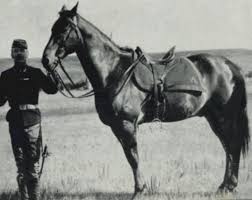
Of course, my eyeball estimate could be a centimetre off, but even being generous, this animal barely crosses the threshold. To drive the point home, compare Clint with historical photos. Here we have one of the most famous horses in American history, Comanche, with his 185cm (6’1″) rider, Captain Myles Keogh. Note how Keogh’s eyes (eyes to crown: 0.5% of body) align with Comanche’s withers. Using our body proportions method, we can estimate the sole equine survivor of Little Bighorn stood 173cm (17 hands) tall – a good size horse, by any standards!

Captn Keogh (185cm) with Comanche,

Now consider this: if even mighty Clint had such a diminutive mount, what of the other, mostly shorter, cowboys who grace the silver screen? Go back and watch the movies and you can answer the question for yourself.

In reality, if actual cowboys tried to ride off into the sunset on such little ponies, saddlebags, guns and all, the animals would not get them more than a few miles from Tombstone before collapsing with fatigue. So why do directors choose to pair these mighty tough guys with the sort of puny ride that daddy’s little princess canters around with at overpriced stables in the Connecticut suburbs?

A few reasons: First, because the pairing automatically makes the director’s cowboy look bigger than he really is – that’s almost always a good thing. More practically, unless you are supremely athletic and dressed appropriately, jumping up onto a real horse is quite hard to do. And having your grizzly desperado drag over the mounting block so he can scramble his way into the saddle would take away from the magic of the screen. Ponies are also smaller, thus cheaper to feed and stable. And if the actor loses his stirrups mid-scene, he is less likely to be hurt from the shorter fall.

Most importantly, Hollywood does this because they can get away with it. Few movie-goers spend much time with actual horses, so they have no point of reference in real life for how big a horse should be.

It’s yet another reason to get off the couch, away from the phone, climb into the saddle and ride into the saloon of real life.

My review of Horatio Clare’s ‘Something of his Art’

Something of his Art: Walking to Lubeck with J. S. Bach by Horatio Clare

My rating: 2 of 5 stars


There is a style of book that populates the shelves of middle class homes, mostly in England. It is a gentle piece of quirky non-fiction into which you can dip on a lazy Sunday afternoon. It feels indulgently erudite, warming the insides of your university-educated ego as you delight in a particularly well-crafted metaphor, or the deployment of a somewhat archaic adjective you imagine other classes of reader would be forced to look up on their phones.
Such is the book Horatio Clare sat down to produce when writing Something of his Art: Walking to Lubeck with J.S.Bach (Field Notes). A sheaf of said field notes – most likely handwritten – lay next to a computer, perhaps held in place by a mug of good coffee, as Horatio set about recounting his ‘adventures’ while recording a BBC documentary that follows the historic walk of Johann Sebastian Bach across the Germany of 1705.
The problem is, Clare largely fails. To be fair, there are exceptionally well-written passages lost in the long and wearisome trek that is this short tract. But its central purpose – to give the reader a sense of the young J.S. Bach and his walk from Central Germany to the coastal city of Lubeck, to meet the then-famous composer Buxtehude – is lost.
We do not get Something of Bach’s Art. Instead we get a rather dry, tired account of three middle-aged men on a work assignment for the British state broadcaster. We learn much about Horatio Clare: he likes birds and wishes Europe had more of them, in that vague way of the comfortable urban naturalist shielded from the realities of the nature he adores. He dislikes right-wing populism, yet he very much likes virtue-signalling that fact. Most of all, he is rather indifferent to Bach’s music and its German cultural context, instead treating it like the work subject we know it was. He does not even bother to hide the fact that the ‘walk’ he takes in Bach’s footsteps is mostly a series of train and taxi short-cuts to the next hotel.
Perhaps not much is known of Bach or his walk to Lubeck, and so Clare had not much to tell without drifting fully into fiction-writing? Perhaps the very idea of walking in Bach’s long-erased footsteps was a silly one? Or perhaps the BBC documentary (that I did not watch) is well-edited in a way these field notes are not, and therefore tells that story much better?
In any event, we do learn something of Horatio Clare’s Art – specifically that he is prepared to put his name to a book that never ought been published; great tits, wood pigeons and all.


View all my reviews

What more am I

What more am I
Than carbon agitation
On a rock?

A brief and pointless
Perturbation;
A speck upon a speck
Within the breath
Of entropic exhalation?

One thing more am I:
A man that hopes and yearns
That through this very poem’s craft
His tiny mind deturns
At least one electron’s path;

That a single quark, a muon
From its entangled destiny –
By the power
Of his human’s will –
Be severed.

And the universe will
Change forever.

On the need to hit the Economic Gym

Christmas is coming, the Graham’s getting fat…
We have moved into the second half of November. The days are short; the temperatures have fallen, as well as a bit of snow against the windowpanes of my 18th Century country home. My fire is lit. Nothing seems more appealing now than comfort food and a blanket, curled up on the couch as I stare into the flames.

Primitive man took fire as a sign from the gods that he should not go to the gym.

Of course, I also know what happens whenever I give in to this caveman temptation. My muscles, honed from a summer of outdoor activity, will quickly grow flabby from lack of use. After all, I am not a caveman. My cupboards are full. There is no evolutionary advantage to redirecting calories from muscle maintenance to the sustenance of biological function. In short, I must hit the gym.

Turn right in 3 metres, swivel, sit on toilet seat. You have reached your destination
What’s true for the body is also true for the mind. For example, some studies show that overreliance on GPS navigation systems can dull your ability to find your way around using your own mental maps. And we know that sudokus and crosswords stave off dementia in the elderly. The concept of honing the mind by hitting the mental gym is as intuitive as the ramifications are horrific, when we consider the growing ubiquity of AI. But that’s a subject for another blogpost.

What I want to talk about is how this principle of ‘mental gym fitness’ might apply to economic efficiency and public policy design. Policymakers know (and sometimes like to forget) that every regulation – however beneficial – has some costs attached to it. On the rare occasions when they do their job properly, they even carry out cost-benefit analysis to make sure that the benefits clearly outweigh the costs.

But what if there were another kind of cost they consistently overlook? What if regulating things that people might be able to sort out for themselves turns out to be, not only annoying and inefficient, but also harmful to our ‘economic gym fitness’?

No pain, no economic gain
Economists tend to think of ‘the rational economic actor’ as a fixed construct. In other words, it is implicitly assumed that we are endowed with a certain level of rationality or otherwise. Some people can decide what is the right level of fluoride to put in their water, but others simply cannot. Some people can make the rational decision to spend more on a car with airbags and a crash cage, but others can’t perform that analysis and, in the absence of safety regulations, will end up buying the ‘wrong’ car.

My hypothesis here is that, while individuals no doubt have innate tendencies when it comes to rational decision-making, we all get better with practice. If you live in a highly regulated society, in which the government decides what food is safe to eat, what cars are safe to drive, what words are safe to say, etc. you forget how to make these kinds of decisions for yourself. Granting freedom of speech doesn’t mean people ‘should’ say anything they like, rather that the State should never use its monopoly on violence to stop them from saying the ‘wrong’ thing. Freedom demands discretion.

Strong states make weak men make hard times
I saw the effects of this first-hand in Bulgaria, when after the collapse of communism public spaces which in Western Europe would be maintained by the community, turned into rubbish heaps and slums. Without a strong State, no one stepped up to fix or clean things. And it has taken recovering communists decades of mental gym work to rebuild that economic muscle mass.

This could be the true cost of the Nanny State: it erodes our capacity to make choices. By taking away our ability to make mistakes, the State also takes away our ability to learn from them. This could have profound effects on the overall efficiency of markets and our economy, while creating a regulatory vicious circle. For example, if consumers believe themselves safe in the knowledge that the State will regulate online shopping monopolies, they won’t feel the need to reflect on whether their one-click purchase from Amazon could have been bought in the local shop instead. Mom-and-Pop Stores die faster and the State needs to step in sooner and harder, with all that that implies: inefficiencies, risk of regulatory capture and exposure to Jeff Bezos’ fiancée’s boobs at the Presidential inauguration.

Hell hath no fury like an overregulated bureaucracy
There is perhaps also a moral dimension to this: If you depart from the premise of Judeo-Christian morality, the ability to do wrong is part-and-parcel of the ability to do right. Theology has it that we are different to the other animals God created not in any superficial anatomical way (opposable thumbs, brain to body mass…) but because we are unique among God’s creatures in having the ability to do wrong – and therefore to do right. The State, by using its monopoly on violence to block our access to the Forbidden Fruit, takes away our ability to make good choices too.

Not even the Devil would do something like that.

My review of Daphne du Maurier’s ‘The Glass-Blowers’

The Glass-Blowers by Daphne du Maurier

My rating: 5 of 5 stars


This is not the first Daphne du Maurier novel you are likely to read. After all, she is much better known for her pacy, plot-driven psychological stories like Rebecca, The Scapegoat or Jamaica Inn.

The Glass-Blowers has little of that. In fact, at the beginning, I found it a little off-putting, because it didn’t quite rise to my expectations. The narrative device, of an opening third person narration, followed by a long first-person letter narration, and a closing third person narration, makes it hard to climb into the action in a way you might expect from a du Maurier.

But here is an excellent example of why readers should apply the 50 page rule before giving up on any book (save perhaps the most obvious trash): This book begins as an unformed lump, at first it’s hard to imagine it could be anything of value. But as du Maurier slowly and methodically breathes life into it, the story takes shape over the course of the French Revolution. It is masterfully crafted, with the contours of each character etched in crystal clarity upon an impeccably told history of the rise of the First Republic, the Reign of Terror and the ascension to power of Emperor Bonaparte.

Like the glass that acts as metaphor throughout, there is both strength and fragility in the Busson family, and especially the narrator and central character Sophie. In fact, The Glass-Blowers is nothing short of an epic; yet it is one that respects the personality of the straightforward and efficient Sophie herself, by managing to fit onto a mere 300 pages. In this, du Maurier shows respect also for the reader; something we know and appreciate from her more celebrated works.

Lovers of A Tale of Two Cities and Les Miserables take note: Dickens and Hugo do not have a duopoly on the market for great 1789 fiction.


View all my reviews